

Why most podcasts die before episode seven (and how to make sure yours doesn't)
There's a word for it in the podcasting world. Podfade.
Prefer to watch? Press play. Prefer to read? Keep scrolling.
It's what happens when a show goes quiet without ever officially ending. No final episode. No announcement. Just a feed that stops updating. Search around the Reddit Podcasting community and you'll see the same story over and over. Someone launches full of energy, gets a handful of plays, hears nothing back, and slowly stops showing up. Not because they failed. Because nobody told them what actually keeps a podcast alive.
Most podcasts that podfade don't die because the idea was bad or the host wasn't capable. They die because too much time went into the things that don't matter yet, and not enough time went into the things that do.
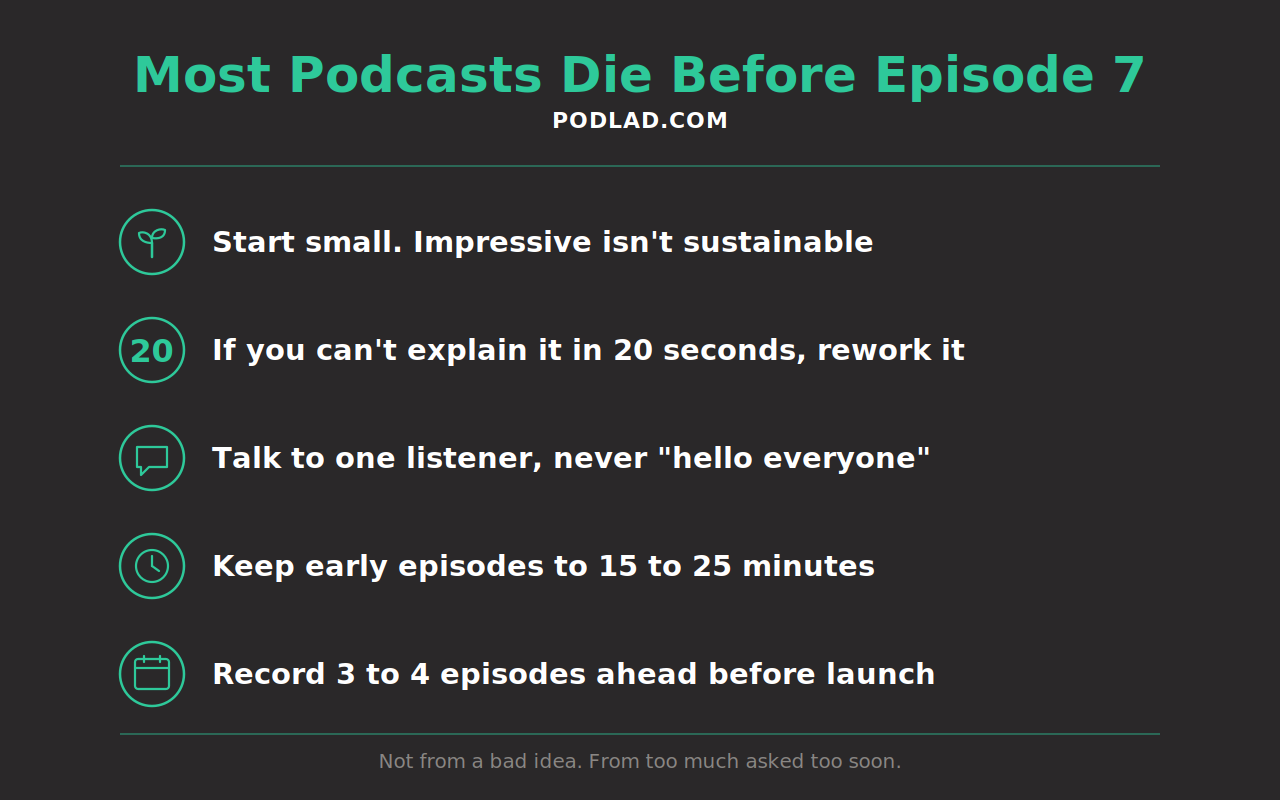
Here's the minimalist guide. No fluff. No links to expensive gear. Just nine steps that give you the best chance of still enjoying this a year from now.
Start smaller than you think you should
Podcasting looks simple from the outside. In reality it asks a lot of you over time. The biggest mistake I see beginners make is going all in straight away, buying gear, lining up months of guests, promising a schedule they've never lived with. A few episodes in, it starts to feel heavy.
Think about a restaurant that opens with a forty item menu on day one. Looks impressive on paper. But imagine the kitchen trying to hold that standard across forty dishes from the first night, quality would drop everywhere at once before the place had even found its feet. The restaurants that last usually open small, a dozen dishes done properly, then expand once the kitchen can actually handle it.
✕ Don't ask how do I make this impressive.
✓ Do ask how do I make this easy enough to keep doing. That shift alone saves most podcasts.
If you can't explain it in 20 seconds, it isn't ready
Broad ideas don't give people a reason to care. Specific ones do. You're not trying to make something for everyone. You're trying to make the right person feel like this was made for them.
It's the same instinct that makes you scroll past a shop sign that just says "general store" but stop for one that says "we only sell vinyl from the 1970s." The narrow one tells you exactly who it's for, and if that's you, you're walking in. The broad one could be for anyone, which usually means it isn't really for you.
✕ Don't settle for a broad subject because it feels safer.
✓ Do narrow in further than feels comfortable. Keep niching down until you could sum it up in 20 seconds.
Be honest about why this exists, from the listener's side
Fame, monetisation, brand building, these might be good reasons for you. They're not reasons a listener can connect with.
Imagine a restaurant that asked you to leave a five star review before your food even arrived. You'd feel it instantly, that's for them, not for you, and it would make you trust the place less, not more. Listeners pick up on the same thing in a podcast within the first minute. They know straight away if this episode is for you or for them.
Before you hit record, finish this sentence, out loud, in full: "This episode is worth listening to because it helps you ______________." If you can't fill in that blank with something specific and true, don't hit record yet.
Keep early episodes shorter and more focused
Most people are busy. They're listening between other things, out on a walk, doing something else with half their attention.
It's the same reason a good barber doesn't try to upsell you a treatment you didn't ask for while you're in the chair. They do the one thing well, you're out the door in twenty minutes, and you book again next month because it was easy. Drag it out and you start dreading the appointment, even if the haircut itself was fine.
✕ Don't aim for an hour because that's what the big shows do.
✓ Do keep it to 15 to 25 minutes. One main idea, one clear takeaway, and your listener feels respected enough to come back.
Don't overspend on equipment
I see this constantly. People spend serious money on microphones and setups, then never release a single episode. Good gear doesn't make you a better podcaster. It just raises the pressure.
Same as someone who buys a full home gym before they've been to a single class. The kit isn't the problem. The pressure to justify the kit is. Most people who actually stick with something started with the minimum and earned their way up to the upgrade.
✕ Don't buy a studio setup before you've recorded a single episode.
✓ Do use a simple USB mic, Riverside or even Zoom. Upgrade once you're still going three or four months in.
Commit to nine months before you look at a single number
This is the step that actually kills podcasts, more than gear, more than format, more than guest lists. It's checking the stats too early and letting them make the decision for you.
From the outside, podcasting looks simple. Start a show, release episodes, get listeners, get customers. Said like that, it sounds like a straight line. It isn't. What actually happens is you learn as you go. What's resonating. What's falling flat. What you enjoy recording and what you dread. Those are the things that should shape your next decision. Not a downloads number that's still warming up.
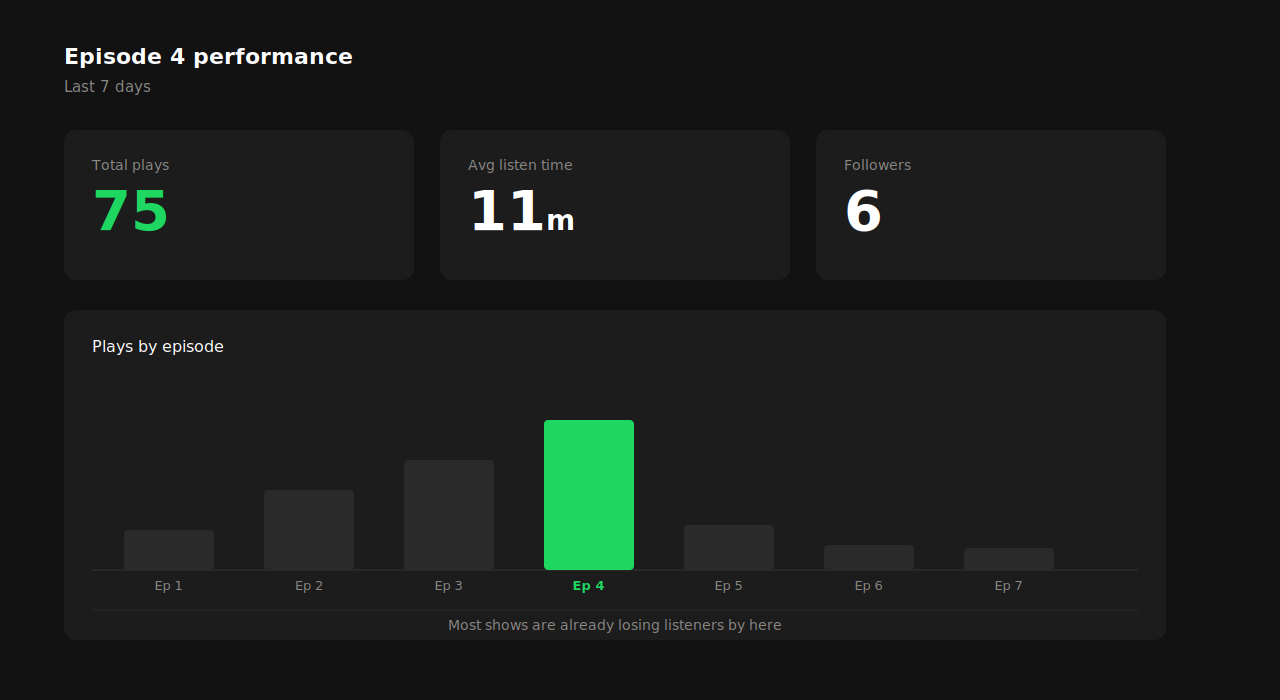
Seventy five plays by episode four feels like proof it isn't working. It usually just means you're early.
If your stats are the thing driving your decisions this early, you will give up fast. Not because the podcast is bad. Because you looked at a number that was never going to mean anything yet, and let it answer a question it can't answer.
✕ Don't check downloads weekly and let them set your mood or your next move.
✓ Do commit to nine months before the stats get a vote. Let your own enjoyment and what's actually resonating with the few people listening be the signal instead.
Talk like a person, not like a host
You don't need a podcast voice or a radio voice. It actually gets in the way, because it's not what people connect with. The shows people are drawn to feel conversational, not performed. That's what authenticity actually sounds like.
Think about the difference between a call centre script reading your name off a screen and a local shopkeeper who actually remembers what you usually order. One feels like a transaction, the other feels like a relationship. Listeners can tell which one they're getting within a sentence.
✕ Don't say hello everyone or tell the audience. Nobody listens to podcasts in a group.
✓ Do talk to one person. Podcasting is the most personal medium there is, people listen alone with earbuds in.
Remember who this is actually for
This is where podcasts quietly lose people. Long backstories and guest biographies that don't help the listener. Early on, the listener is asking one question. Why should I keep listening.
It's the same as walking into a shop and the assistant spending five minutes on the company's history before you've even asked where the milk is. You came in for something specific. Get them there fast and they'll trust you with the next ask too.
✕ Don't open with a general intro, a please subscribe, then a resume style guest bio.
✓ Do keep the listener in mind from the first line. Your episodes will tighten up naturally.
Decide the tension and outcome before you hit record
What's the tension. What's the challenge. What will someone understand by the end that they didn't at the start. Answer that and the questions, the edit, the title, the thumbnail all get easier.
It's like booking a plumber because they're nice company, rather than because your sink is leaking. The nice person might be lovely to have round, but they don't fix anything. Book the guest because they solve a specific problem for your listener, not because they'd be fun to talk to.
✕ Don't build a list of impressive sounding guests and build episodes around them.
✓ Do build a list of topics and tensions first, then find the right guest for each one.
Record ahead and take the pressure off
Don't launch with one or two episodes ready. Build a buffer, three or four episodes deep, before you commit to a release schedule.
Same logic as a café that preps ingredients before the lunch rush rather than chopping onions while someone's standing at the till waiting. The prep work is invisible to the customer, but it's the only reason the rush feels calm instead of chaotic.
✕ Don't commit to weekly with nothing in the bank. It catches up fast and you'll panic book a guest who isn't a fit.
✓ Do keep a buffer. Calm, steady releases beat rushed ones every time.
Most podcasts don't fail because the people making them weren't capable. They fail because too much was asked too soon, and because the stats got a vote before they'd earned one. Keep things simple, give it nine months, think about the listener first, and you're already ahead of most of what's out there.

You don't have to figure this out alone
Bren Russell, Podlad
I spent 17 years in broadcasting at RTE, the BBC and MTV before I left to build Podlad from a spare room. Since then I've worked with independent podcasters and business owners across Ireland, the UK and the US, helping them get a show off the ground without burning out or overspending.
A second pair of eyes doesn't have to mean handing your whole show over and paying a monthly retainer. Most of the podcasters I talk to just need someone who's actually done this to sense check the idea, tighten the format and tell them honestly what's working before they record fifty episodes the hard way. That's often a single conversation, not an ongoing cost.
It's the same as getting a second opinion before you sign a contract. You're not hiring the person forever. You're just making sure you don't find out you got it wrong nine months too late.
Book a free 20 minute intro call
No pitch, no pressure. Just an honest look at where your podcast is and what would actually move it forward.
