Do you need expensive equipment to start a podcast? (No, and here's the proof)
If I was about to tell you how to make a million dollars, would you care that I had a high definition camera? Would you care that I had the best microphone on the market? Or would you just want the message?
That question is at the centre of pretty much everything I've learned watching podcasters succeed and fail over the years. The ones who fizzle out after a few months almost always made the same mistake at the start. They obsessed over the flash and forgot about the message.
Here's the proof. The single biggest episode I've ever produced was recorded by a guest using nothing but the microphone built into her laptop. No studio. No external mic. It's now one of the best performing episodes on the entire channel, by a wide margin. I'll show you exactly how wide a bit further down.
The clients who obsess over polish rarely stay long
I come from a broadcast background. For years I told people to get their audio up to a certain standard, their video up to a certain standard, to represent themselves professionally. That advice isn't wrong exactly, but I've watched it become the wrong priority at the wrong time.
The new clients who arrive wanting their audio polished, their ums and ahs removed, every imperfection sanded down, are very often the ones whose message isn't right yet. They're trying to fix the wrong problem. I don't keep those clients for long, not because I don't want to help them, but because polish was never what was missing.
It's like a restaurant spending its entire budget on the dining room furniture before anyone's tasted the food. A beautiful room doesn't bring people back. The food does. The room is what you upgrade once people already want to be there.
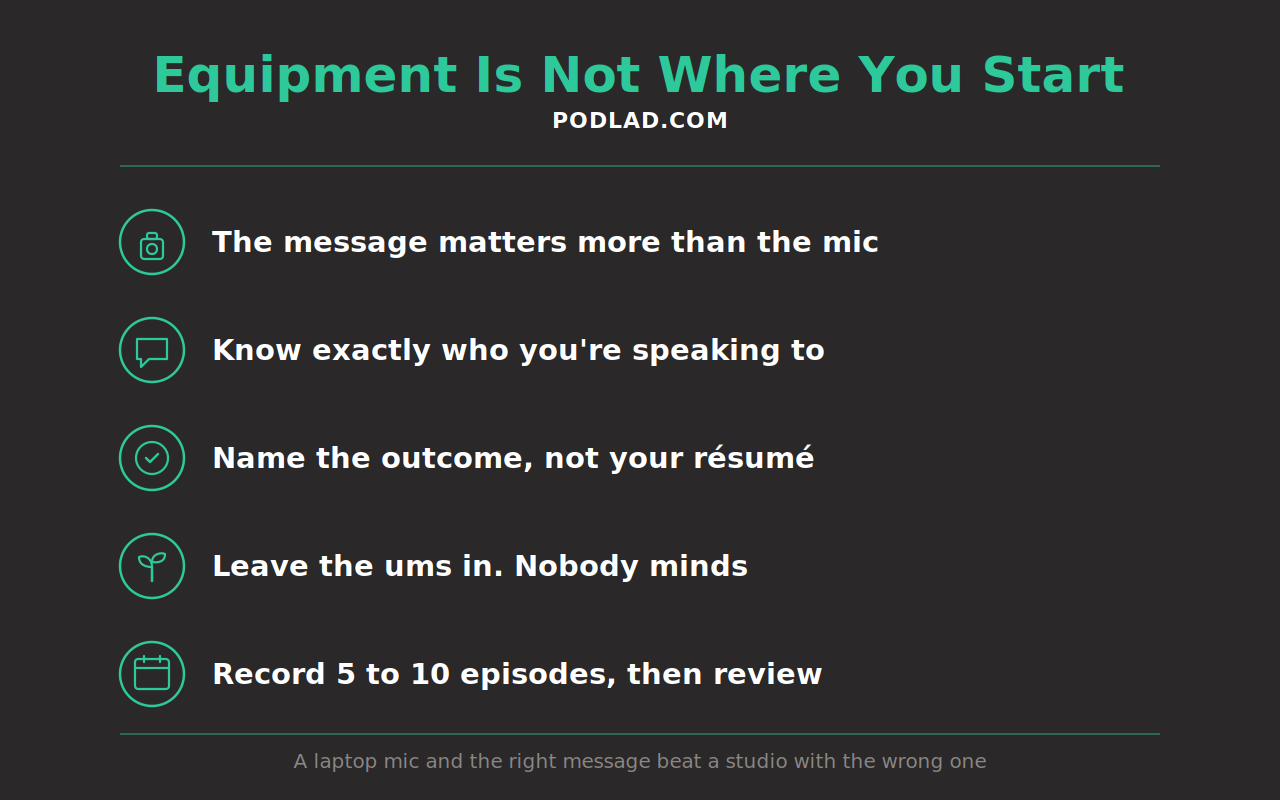
✕ Don't ask for your ums and pauses removed before you've nailed down who you're actually talking to.
✓ Do get the message right first. The polish is a later problem, and often it turns out to barely be a problem at all.
My biggest success used a laptop microphone
The Wiser Than Before Podcast is the clearest example I have. The biggest episode on that channel has passed 112,700 views on YouTube. The guest on that episode had no external microphone. Just whatever was built into her laptop. It doesn't sound polished. It sounds like a real conversation between two people who knew exactly what they were talking about and who they were talking to.
This is that episode. Built in laptop mic, no studio, no script. Still the single biggest result this channel has produced.
That episode has generated real leads for the host. People booked calls because the message was clear and it resonated, not because the audio hit some technical benchmark. They knew who they wanted to speak to, knew what problem they wanted to solve, and talked about it like two real people rather than performing a podcast.
✕ Don't assume a result like that requires a result like that level of production.
✓ Do notice that the thing driving 112,700 views and real client leads was never the equipment. It was a specific audience and a specific problem, talked about by two people who actually understood both.
People are bored of podcasts that perform podcasting
So many new shows copy the format of bigger podcasts without copying what actually made them work. A scripted hook. An intro that says "without further ado." A host voice instead of an actual voice. None of it connects, because none of it is real, and listeners can tell the difference within seconds.
The same thing happens with guests. "Tell me about yourself" gets you a resume, CEO of this, president of that, award winner several times over. Nobody cares. Nobody ever asks what you've achieved because they're curious about your achievements, they're asking because they want to know if you can help them with something specific.
Think about the difference between a tour guide reciting dates and facts from a script, and a local who just tells you honestly which street to avoid at night and where they actually eat. One is informative. The other is useful, because it's specific and it's real.
✕ Don't open with a generic intro about how great the podcast is, or let a guest introduce themselves with a list of accolades.
✓ Do get straight to what the guest is going to help the listener with. That's the only thing they're actually waiting to hear.
Who am I speaking to, and what outcome am I helping them reach
This is the sentence I'd want every podcaster to be able to finish before they hit record on any episode. I help which specific audience achieve what specific outcome. Not a vague niche. Not "entrepreneurs" or "people interested in wellness." A specific person with a specific problem.
Do that work for every single episode, not just for the show as a whole. If you're bringing on a guest, know exactly what problem they're going to help someone solve before you start recording, not while you're editing and trying to find an angle afterwards.
✕ Don't record first and figure out the angle in the edit.
✓ Do answer the audience and outcome question before you press record, every time, even when it feels repetitive to keep asking it.
Trying to sound professional is the wrong starting question
Most podcasters work backwards. They start by asking how can I sound professional, how can I look polished, how can I seem credible. That question never actually matters until you've answered a different one first. How can I be helpful. Get that right and credibility takes care of itself. Get it wrong and no amount of polish fixes it.
Two examples I see constantly, both doing the exact same damage in different forms. The first is blurring your background on camera. It's meant to look clean and professional, and instead it creates instant distance. A blurred background says studio, says corporate, says this isn't really my home or my space, you're not actually welcome in here. The second is running your audio through an AI tool to strip out every um and pause. Nobody was bothered by your ums in the first place, not if what you're saying is actually useful. Removing them doesn't make you sound smarter. It just removes the thing that made you sound like an actual person.
Both choices come from the same instinct, smooth over anything that feels human in case it looks unprofessional. And both choices create the exact distance they were meant to remove. The fix isn't more polish. It's asking whether the thing you're about to clean up was actually a problem for anyone, or just a problem for how you imagined you were supposed to sound.
✕ Don't blur your background or scrub every um and ah from your audio in the name of sounding professional.
✓ Do ask how you can be helpful first. Professional is a side effect of that, not a separate task you need to manage.
Hit record, then build outward from there
If you're thinking about starting a podcast, my honest advice is to start recording one. Don't wait for the studio, the lighting, the perfect mic setup. Record it in a box room with a messy pile of clothes still sitting in the corner where you haven't gotten around to putting them away. Nobody scrolling past cares about your background. They care whether what you're saying is useful.
Do five to ten episodes like that. Then stop and look honestly at what's working and what isn't. Improve from there, brick by brick, rather than trying to arrive at a perfect podcast on day one. Starting this way is also a lot cheaper. No studio, no expensive editor, no platform fees you didn't need yet.
✕ Don't wait until the setup feels perfect before you start.
✓ Do record five to ten episodes exactly as they come out, then review and improve. You'll learn more from that than from another month of researching equipment.
I've changed how I work because of this. I used to be the person who'd polish your audio and clean up your room tone. Now the thing that actually moves the needle for clients is helping them get the message right first. That's where podcasts succeed or stall, long before the microphone ever enters the conversation.

You don't have to figure this out alone
Bren Russell, Podlad
I spent 17 years in broadcasting at RTE, the BBC and MTV before I left to build Podlad from a spare room. Since then I've worked with independent podcasters and business owners across Ireland, the UK and the US, helping them find the message before they ever worry about the microphone.
A second pair of eyes doesn't have to mean handing your whole show over and paying a monthly retainer. Most of the podcasters I talk to just need someone who's actually done this to sense check who they're really talking to and what they're actually offering them. That's often a single conversation, not an ongoing cost.
I never hard sell. If I'm not the right fit, I'll tell you that too.
Book a free 20 minute intro call
No pitch, no pressure. Just an honest look at where your podcast is and what would actually move it forward.
