The 7 mistakes quietly capping your podcast's growth
I talk to podcasters every week who are doing everything they think they should be doing and still can't grow an audience. Almost every time, it comes down to one of the same seven things.
None of these are about gear, or talent, or luck. They're decisions, made early and rarely revisited, that quietly cap how far a podcast can go. Here they are, with what I'd actually do about each one.
Your niche is too broad
You've heard this one a hundred times. I'm going to go further than most people do with it, because knowing you need a niche and actually finding the right one are two different skills.
The biggest growth I've seen with any client happened when they found a niche inside their niche. I worked with the Wiser Than Before Podcast, hosted by Josh Dodds, on chronic health conditions. The audience was people struggling to get answers through conventional medicine. Episodes were getting 100 to 200 views, solid but unremarkable. Then we released an episode on histamine intolerance. It's since passed 110,000 views, more than ten times anything else on the channel. That wasn't an accident, it was the niche inside the niche.

That's this episode, the one I keep coming back to in this post. More on just how big that gap really got a bit further down.
Think of it like a restaurant that says "we do food" versus one that says "we do nothing but Neapolitan pizza, made one way, since 1987." The second one tells you exactly what you're getting before you've even read a review. That's what a niche inside a niche does for a listener deciding whether to press play.
✕ Don't stop at the first niche you land on. "Fitness" or "alternative health" is a category, not a niche.
✓ Do go three levels deep. For Wiser Than Before that looked like alternative health, then chronic health conditions, then histamine intolerance specifically. Your core audience should live at level three.
Your ideal listener isn't defined
When someone tells me their podcast is for "everyone," I already know it's going to struggle. Targeting everyone means appealing to no one, and it makes every decision after that point harder than it needs to be, the topics, the titles, the guests, all of it.
It's the same reason a shop that sells "outdoor stuff" loses to one that sells "gear for cold water swimmers, run by a cold water swimmer." The second one knows exactly who's walking through the door and exactly what to say to them.
The fix is building a full character profile of your one ideal listener, in enough detail that you could write them a personal email. Here's one I built for a freelance and business podcast aimed at men in their thirties who want to leave secure jobs and build something of their own.
Meet Hesitant Harry
37 years old, married, expecting his first child. Fifteen years in a media job he's outgrown, under a boss he doesn't respect. Stable income, but capped. He wants to build something of his own using the skills he already has, but he's stuck telling himself there isn't enough time.
His commute is the thing that frustrates him most, wasted hours he resents every single day. He's not lazy, he's overwhelmed, juggling a job, a side hustle, a marriage and a baby on the way, and he regrets how little progress he's made toward the thing he actually wants.
A podcast built for Harry turns that commute into the most useful twenty minutes of his day. Short, focused episodes. Practical steps broken into pieces small enough to act on between meetings. Real stories from people who left stable jobs and made it work, so he knows he's not the only one who's scared.
Once you have an avatar, even a rough one, everything should align with it. The artwork, the language in your titles, the topics, the guests you choose, all of it should feel like it was made specifically for that one person.
✕ Don't describe your listener by demographics alone, age, gender, location. That tells you almost nothing about how to talk to them.
✓ Do write the emotional triggers. What frustrates them. What they feel guilty about. What excuse they keep repeating to themselves. That's what your titles and topics should speak to.
Your episodes don't have a clear value
This follows straight on from the last point. Your podcast needs a defined listener, but every single episode needs a defined topic too. Too many shows are built around a guest rather than a topic, and a guest is hard to package, hard for a listener to understand the value of before they click play.
Listeners don't care about the guest. They care what they can learn from the guest. Those are two very different things, and the gap between them is the difference between a podcast that grows and one that doesn't.
Imagine someone interviewed me with no preparation. You'd end up with a title like "Bren Russell, founder of Podlad" or "How he built a podcast business." Technically accurate. Nobody clicks on it, because nobody knows who I am and a title like that doesn't tell them what's in it for them.
Now imagine the host did the work first. They'd learn I left a secure job to build something of my own, and suddenly there's an angle that connects with anyone who's ever thought about doing the same thing. The same interview becomes "Quitting the 9 to 5: how he doubled his earnings working for himself" or "Overcoming fear: the mindset shift that led to financial freedom." Same guest, same conversation, completely different pull, because now it's about the listener's outcome, not my biography.
✕ Don't build an episode around "chatting with" a guest about what they do.
✓ Do pick the single outcome the listener walks away with, then choose the one angle from your guest's experience that delivers it. Decide this before you record, not in the edit.
Your audio quality is poor
Bad audio is everywhere in podcasting, and it's one of the easiest problems to fix. If you're not using a dedicated mic, even a simple budget headset mic is a meaningful upgrade from a laptop's built in microphone.
I hear "my audience doesn't care about bad audio" a lot. As someone who comes from a broadcast background, that was hard to accept at first, but I've seen the evidence. Some of the best performing episodes I've worked on had a guest with rough audio, and it didn't hurt the episode at all.
Here's the distinction though. Listeners have become tolerant of bad audio on the guest side, as long as the content holds up. They are not tolerant of it on the host side. Your voice is the first thing they hear, every episode, and it represents the whole show. We don't expect a guest to be an audio expert. If you're calling yourself a podcaster, the bar is higher for you specifically.
✕ Don't assume rough host audio gets the same pass as rough guest audio. It doesn't.
✓ Do invest in clean audio for your own voice specifically. A simple, inexpensive mic closes most of the gap.
Don't let early numbers make the decision for you
The histamine intolerance episode that hit 110,000 views didn't happen in week one. It happened about four months in, after a stretch of episodes pulling 100 to 200 views each. If the stats had been the only signal, that podcast might have been shelved before it ever found its breakout topic.
This is the part that actually determines whether a podcast grows or quietly disappears. Not the niche, not the avatar, not the audio, all of those matter, but none of them matter if you give up before you've learned enough to know what's working. From the outside, growing a podcast looks like a straight line, pick a niche, release episodes, get listeners. It isn't. It's a process of learning what resonates and what falls flat, episode by episode, and that takes longer than most people expect.
✕ Don't judge a niche or a format by the first few months of numbers alone.
✓ Do commit to a runway, nine months is a reasonable one, before you let downloads or views decide whether something is working. Let what's actually resonating with the listeners you do have guide your next move instead.
You're relying too much on AI
AI is useful. It's not a replacement for thinking, and far too many podcasters are letting it run the parts of the show that actually need a human point of view, titles, show notes, clip selection. The result is content that blends into a generic crowd in a space where standing out is the entire game.
The tell is almost always the same. AI generated copy reaches for an overpromise, a colon, and a broad summary. Once you've seen it a few times you'll spot it everywhere.
AI TITLE
"Embracing Self-Acceptance: Transforming Your Relationship with Food and Body Image"
WRITTEN BY A PERSON
"What You're Really Losing to Diet Culture (It's Not Weight!)"
Show notes follow the same pattern, AI tends to produce a menu of what was discussed rather than something written from the listener's point of view. Two short paragraphs in your own voice, even with rougher language, will outperform a polished AI summary, because it's the one thing AI still can't fake.
Clips suffer the worst from this. A clip lifted straight from the transcript and played back exactly as recorded is rarely entertaining, because AI is matching power words on a page, not understanding what actually made a moment land. A proper short takes fifteen seconds from one part of the conversation and fifteen from another and edits them together with intention. That's the version that performs, and it's not something AI does well yet.
✕ Don't let AI write your titles or show notes straight from the transcript and publish them as is.
✓ Do use AI for ideation, then write the final version yourself, in your own voice, with the specifics only you would know.
You're not on YouTube
There's a misconception that putting a podcast on YouTube means a fancy studio and a movie style intro. It doesn't. Plenty of remotely recorded podcasts are getting real traction there with nothing more than a camera pointed at the conversation.
The Wiser Than Before Podcast launched with zero existing audience and a host with no public profile. Here's the clearest proof I have of what YouTube does that audio alone can't. The histamine intolerance episode mentioned earlier sat at 218 listens on audio only platforms. The same recording, same edit, posted to YouTube the same day, has passed 112,700 views.
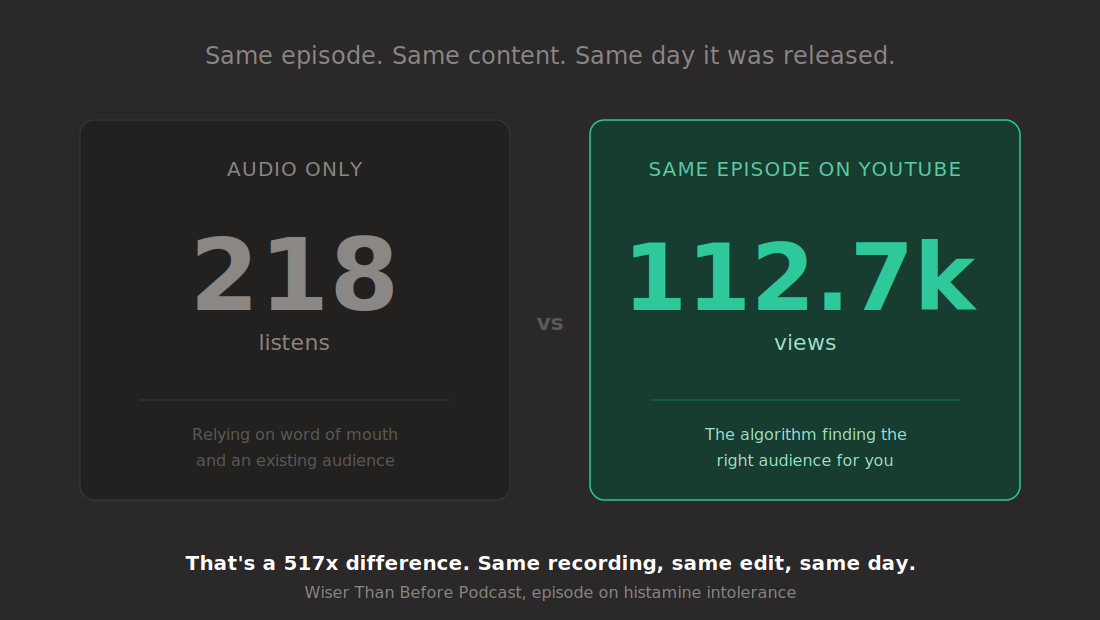
That's not a different episode performing better. It's the exact same content. The only thing that changed was where it was published. An audio only show depends on word of mouth or an existing audience finding it. YouTube actively puts your content in front of the people searching for it, it does a meaningful part of the marketing for you.
The full episode that did 112,700 views on YouTube against 218 audio listens.
A repurposed short from the same episode, part of the wider YouTube view total.
The data in YouTube analytics is also so powerful. It will tell you how many viewers watch to the end, where they drop off, if they are engaging with the content. With that, if you look at it honestly, you will be able to tell where the problems are in your podcast.
Reach is how many people YouTube has shown your video to. Under 3,000 for a new channel usually means the algorithm hasn't found an audience for it yet, that's your first signal something needs to change.
Click through rate is the percentage of that reach who actually clicked. Anything over 5% is solid for a small channel. Lower than that points to a title or thumbnail problem, not a content problem.
Watch time matters more than views. A sharp drop in the first 30 seconds usually means the opening doesn't deliver on what the title promised.
Comments are the most honest signal of all. Thousands of views with no comments, or only generic ones, is often a sign of paid promotion rather than real engagement. You can fake views. You can't fake engagement, and engagement is what your podcast actually grows on.
✕ Don't post aimlessly and expect the algorithm to find your audience for you.
✓ Do release consistently for a few months, then read the analytics honestly and let them guide what you make next.
You don't have a podcast producer
There's a genuine amount of thinking that has to happen behind every consistent podcast, niche, avatar, episode structure, audio, packaging, YouTube strategy. Most people don't have the time to learn all of it and execute it well at the same time, and that's not a failure, it's just the reality of running a one person operation.
A producer isn't the same as an editor. An editor takes finished content and makes it sound and look like a podcast, a technical job. A producer should be helping with everything above, the strategy as much as the execution, and should be there to grow the show, not just turn out the next episode on schedule.
It's the same as getting a second opinion before you sign a contract. You're not handing the whole thing over forever. You're making sure you're not finding out you got something wrong nine months too late.
None of these seven things require more talent or a bigger budget. They require slowing down at the start and making a few decisions properly instead of skipping past them. Get the niche, the listener, and the episode value right, and the rest gets a lot easier.

You don't have to figure this out alone
Bren Russell, Podlad
I spent 17 years in broadcasting at RTE, the BBC and MTV before I left to build Podlad from a spare room. Since then I've worked with independent podcasters and business owners across Ireland, the UK and the US, helping them get a show off the ground without burning out or overspending.
A second pair of eyes doesn't have to mean handing your whole show over and paying a monthly retainer. Most of the podcasters I talk to just need someone who's actually done this to sense check the niche, the avatar, the packaging, and tell them honestly what's working before they spend a year guessing. That's often a single conversation, not an ongoing cost.
I never hard sell. If I'm not the right fit, I'll tell you that too.
Book a free 20 minute intro call
No pitch, no pressure. Just an honest look at where your podcast is and what would actually move it forward.
