How much does it cost to make a podcast? Less than you think.
Here's the honest number. You can start a podcast properly for under $100, or for close to nothing if you're willing to use free tools instead. Both routes work. Here's exactly what each one looks like.
Under $100 upfront, then a small monthly cost
This is the exact stack I recommend to almost every beginner I work with. Nothing on this list needs replacing once you've got it. It just gets used. The cleanest way to think about it is in two separate buckets, what you pay once and what you pay every month.
Upfront, one time
Samson Q2U microphone — $99
A USB mic that plugs straight into your laptop, no interface, no extra cost to make it work. Think of it like learning guitar. You wouldn't go straight for the most expensive guitar on the wall, you'd choose something solid and affordable that lets you actually learn to play. The Q2U is that guitar. It'll genuinely last you forever if you need it to, and the option to upgrade is always there once you know what you'd be upgrading for.
One thing worth knowing. It needs to be within a few inches of your mouth to actually sound good. Hold it while you talk, or get a proper adjustable mic stand or boom arm. Skip the small stand that comes in the box, it doesn't get the mic close enough to make a real difference.
Monthly, recurring
Riverside — free to start, $15 a month if you outgrow it
Records locally in your browser so the quality holds even on a shaky connection, and it comes with its own built in editor, so there's no separate editing software to buy or learn. You can try Riverside here.
Transistor — from around $12 a month
Upload your episode once and it's distributed automatically to Spotify, Apple Podcasts and everywhere else your audience listens. No separate submissions, no chasing platforms one by one. Take a look at Transistor here.
So the real shape of it is this. A one time cost of $99 for the mic, then somewhere around $12 to $20 a month once you're recording and hosting properly. That's a properly set up podcast, recorded well and distributed everywhere, for less than the cost of a single dinner out, and a monthly cost smaller than most streaming subscriptions.
Cover art — optional, $100 to $300 if you go professional
This is the one cost on this list that's genuinely optional, and it's a once off fee rather than anything recurring. If you want something properly designed from the start, $100 to $300 is a reasonable amount to pay for it. My advice if you're just starting out is to stay lean and clean, a simple cover you put together yourself, and upgrade once you know the podcast is something you're sticking with.
$99 upfront, $0 a month after that
If even the small monthly cost above feels like too much commitment before you know whether you'll stick with this, there's a genuinely free version of the same setup, recording and hosting included.
Zoom to record
It's free, almost everyone already has it installed, and it gets the job done for a solo show or a simple two person conversation. It won't give you Riverside's separate local tracks, but for a first run of episodes, it's enough.
Spotify for Creators to host
A free hosting option that still gets your show out to the platforms that matter. It's not as polished as Transistor, but it removes the only real barrier left, somewhere for the episode to actually live.
Canva or an AI tool for cover art
You don't need the $100 to $300 version yet. A simple design pulled together in Canva, or generated with an AI image tool, is enough to launch with. It does the job while you find out whether the podcast is something you'll actually keep going with.
So can you launch a podcast for free, or run one with effectively no budget at all? Almost. Free recording, free hosting, free cover art. The one upfront cost I'd still keep is the $99 microphone. Everything else here can genuinely cost nothing.
Even on the free tier, don't skip the mic
You could start with whatever microphone is already built into your laptop. Plenty of people do. But it's a bit like trying to learn guitar on a kiddie guitar. Technically it makes a sound. It's not going to teach you much about how to actually play, and you'll spend more time fighting the instrument than learning anything from it.
A proper microphone, used correctly, does something a laptop mic can't. It gives you confidence and reassurance that you're covering the single most basic principle of podcasting, being heard clearly. Everything else on this list can be free. This is the one place where a small spend changes how the whole experience feels, right from episode one.
✕ Don't record your first episodes on a laptop's built in microphone to save the last $60.
✓ Do spend on the mic first if you're spending on anything at all. It's the cheapest piece of equipment on this list and the one that matters most.
The real cost isn't money, it's time
Every number above is small. The cost almost nobody accounts for properly is time, and it's the one that actually determines whether a podcast goes anywhere. "It's just talking" is something I hear constantly, and it's definitely not just talking.
The clearest sign of a podcast that's about to waste a lot of someone's time is one built around a category instead of an audience. "I have a marketing advice podcast." "CEOs share their insight." Shows like that go absolutely nowhere, not because the guests aren't interesting, but because nobody knows who it's actually for. A category isn't a podcast. It's a shelf.
Compare that to something like "a podcast for women over 40 who want to launch their own business after having kids." That's specific. That's legible in a single sentence. Anyone hearing it instantly knows whether it's for them, and so do you, every time you sit down to plan an episode or pick a guest. Figuring that sentence out, properly, takes real time and real thought, far more than picking a microphone ever will. Skip it, and every other hour you spend on the podcast is spent without a clear target.
✕ Don't start with a category. "A podcast about marketing" or "a podcast for entrepreneurs" tells nobody anything.
✓ Do get to one concrete sentence. Who exactly is this for, and why exactly are they going to listen.
That's where the real time goes, and it's also where I can take the most off your hands. Production handled, start to finish, so the hours go into figuring out who this is for and why they'll listen rather than into editing software and upload menus. Here's what that actually looks like for one client.
The YouTube strategy most podcasts never get
Recording the episode is the easy part. Getting it found is the actual work, and it's where I bring strategy most producers don't. Here's what that looks like in practice.
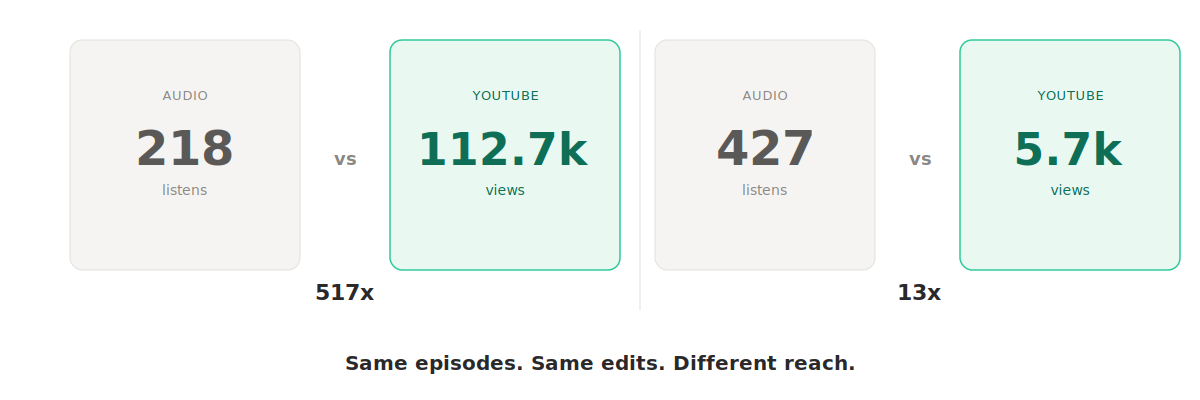
218 listens on audio. 112,700 views on YouTube.
427 listens on audio. 5,700 views on YouTube, still climbing.
Same client, same recording quality. The YouTube strategy is the difference between 218 listens and 112,700 views.
Together we'd build a plan that actually scales the show, not just a list of episodes published into the void.
If you've worked through the numbers above and you're wondering what it would actually cost to hand the production side to someone else, you don't need to guess or book a call just to find out.
Get an instant quote
Pick the services you'd actually want and get a real number back immediately. No call, no waiting on an email.
See your price →
Want your time back?
Bren Russell, Podlad
I spent 17 years in broadcasting at RTE, the BBC and MTV before I left to build Podlad from a spare room. Since then I've worked with podcasters and business owners across Ireland, the UK and the US, taking the production work off their hands so the time they do have goes into the part that actually matters.
Not only does the production get handled end to end, we figure out together who the podcast is really for and a plan that actually scales it, rather than just a steady stream of episodes with nowhere to go.
I never hard sell. If I'm not the right fit, I'll tell you that too.
Book a free 20 minute intro call
No pitch, no pressure. Just an honest look at where your podcast is and what would actually move it forward.
